23 May 13

Telling a Powerful Story

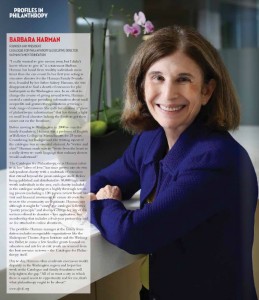
by Barbara Harman

Individual donors make up approximately 75% of the donating public, a pretty important fact for nonprofits to keep in mind when they are telling their stories to others – to the individual donor him or herself (women make up more of that 75% than do men), to the website visitor, to the newsletter reader, to the thank you note recipient, to the reporter. But as demonstrating one’s impact, proving one’s financial transparency, and clarifying one’s ROI become ever more important, it’s easy to let the plain business of telling the story get lost.

That would be a shame. While donors do indeed want to know that nonprofits are doing important work, and doing it with excellence and impact, and while they absolutely want to know that charities are financially sustainable and sound (this is why the Catalogue’s vetting process is one of our most valuable assets), the majority of donors is still, I would argue, waiting to be moved, waiting to hear or read something that resonates personally, waiting to learn where the need is and where it is best being met.

This is why – perhaps more impulsively than is good for us – we are willing to text away our bank accounts in the face of a disaster, sometimes without even knowing where our money is going. (Personally, I don’t think this is a good thing, though I am sure the impulse behind it is good; we should all know to what use our funds will be put before we give them away.) We see the need – often in powerful images, as we did last month in the aftermath of the Boston Marathon bombings and as we have in recent days in the wake of the terrible tornadoes in the Midwest. (For those who want to do their research and decide where best to give, take a look at this list of disaster relief organizations working in Oklahoma.) The stunning images of devastation, whole towns wiped out in seconds, one house standing here while its neighbor is gone there, and the accounts told by survivors – all these speak powerfully to the painful loss of those whose friends and family members died, and the needs of those who must remake their lives in the aftermath of this terrible disaster.

Stories of real need move us, and there are many such stories to be told – some more immediate and dramatic than others, and…many more than there should be. The problem is, we aren’t always very good tellers. We get bogged down in our own internal languages – jargon of the trade, insider talk that only our colleagues understand, a too-numerical view of what “impact” means. We need to speak to each other in a human voice, help the reader understand what the real need is that we are meeting and why it deserves the reader’s attention. We need to describe what we are doing to meet the need in a way that conveys important information that is still compelling and coherent (not a list of seemingly unrelated programs). We need to talk about impact – through powerful metrics if we have them, but in narratives if we don’t. We need to convey our vision of the future in a way that is inspirational and aspirational. And we need to communicate to donors, directly or indirectly, how a contribution to our cause will make a genuine difference.

Above all, we need to speak in a human language, a human voice – individual to individual, person to person, as members of one human community. In fact, helping readers to see that we are indeed members of a shared community is perhaps the best way to help them see the power and importance of joining the cause.

Barbara Harman gave a version of this talk at the America’s Charities Members’ Meeting on May 21, 2013.

23 Apr 13

Stimulating Change: LearnServe International’s 4th Annual Panels and Venture Fair

by Sherika Brooks

The Figuring Out College Success team after their big win at LearnServe's 4th Annual Panels and Venture Fair

Never doubt that a small group of thoughtful, committed citizens can change the world; indeed, it’s the only thing that ever has.” — Margaret Mead

This past Thursday, I had the pleasure of being a judge at LearnServe International’s 4th Annual Panels and Venture Fair at the School Without Walls. LearnServe International empowers high-school students from around the DC area who have the motivation (but perhaps not the means) to make a difference. Through their Fellows Program, LearnServe helps guide students through the creation of their own “social venture.” This year’s Venture Fair featured 60 young entrepreneurs who represented 30 high schools in 4 different counties. What do all of these young entrepreneurial minds have in common? They all helped to design 45 different social ventures with the goal of serving their schools and their communities.

In the cafeteria of the School Without Walls, LearnServe fellows set up their presentation boards and prepared to discuss their ideas with leaders from both the business and community worlds. Students were split into 4 groups: DC Public and Charter Schools/PG County Public Schools, Montgomery County Public Schools, Fairfax County Public Schools, and Independent Schools. Students were judged based on three different categories: innovative ideas, presentation boards, and their venture pitch. Awards were presented to the one group from each category that received the overall high score from the judges. Winners won a certificate, a book, and a pro-bono consulting service session with business leaders from different companies in the area.

As a judge, I reviewed five different ventures, each one as impressive as the next. It was extremely inspiring to see high school students who were all so motivated to make changes within their communities and beyond. Of all the ventures, one group that I judged not only caught my eye, but had the highest score in their geographic region, and therefore, won. Figuring Out College Success (FOCS) is a venture started by Nancy, Zora, Yousef, and Spencer, all sophomore students, with a goal of making the college preparation and application process easier for students. Whether they are students from international backgrounds, working class families, or first-generation college goers, the mission of FOCS is to help effectively transform the frustration and discouragement of the unknown into motivation to pursue the college path. As four young students who have not yet been through the college preparation or application process yet, their goals proved to be one of the most impressive portions of their venture proposal.

  • increase enrollment in Honors, Advanced Placement or International Baccalaureate classes by 10%
  • ensure participants, by mid freshman year, have a developed relationship with their counselor and have a plethora of extracurricular activities under their belt
  • have participants by mid sophomore year create a pool of teachers for recommendations
  • have junior year participants who by their second semester have a full resume and have visited multiple 4-year institutions up the East Coast
  • ensure that by senior year participants have applied to multiple colleges and have set up permanent financial plans for the school they’ll be attending

As a first time judge for the LearnServe Venture Fair, I was blown away by original and transformative ideas that these young people had come up with. It’s refreshing to see so many young people willing (and able) to change the world, and LearnServe provides them with a great platform to do so. Congratulations to all of the winners, the participants, and everyone at LearnServe who helped to put on an extremely stimulating event. To learn more about LearnServe International and all of the programs that they provide, click here.

05 Mar 13

Hidden Issues

by Julia Cain

Yesterday, in The Daily Wrag (Washington Regional Association of Grantmakers), President Tamara Copeland explored “What sequestration means for philanthropy:”

I want to focus on the hidden issues. Much of the impact connected to sequestration will be far less overt. The social worker in me says that as already stressed individuals deal with this reality, mental health-related incidents will also increase. There may be increased incidences of domestic violence, more emergency room visits and falling school performance as home environments become tense. Consider this article about the recession’s impact on our region’s mental health, written when our local economy was actually faring better than the rest of the country.

“The Recession’s ‘Silent Mental Health Epidemic,’ the October 2011 Business Insider article to which Copeland points, discusses a Rutgers University study of “the long-term unemployed,” which found that “32 percent were experiencing a good deal of stress” and “at least 11 percent reported seeking professional help for depression.” Moreover, many more did not have the insurance benefits or financial resources to seek such help, despite potentially needing it.

As Copeland suggests, while our region’s funders should of course ensure that basic needs are met, “it is critical that we keep in mind the less obvious needs [as] a failure to support those, particularly mental health care, can lead to dire consequences.” She also points out that, as much or more so than sequestration, tax reforms could have a critical and perhaps longer-term effect on the national and local nonprofit community.

What are your thoughts? What might be the more “hidden” effects of sequestration?

27 Feb 13

In The News …

by Julia Cain

White House estimate spells out tough road for Washington region economy (Washington Post): “… the upcoming automatic spending cuts the Obama administration detailed Sunday would strike a tough blow, with nearly 150,000 civilian Defense Department employees facing furloughs and an estimated average loss of $7,500 in pay [...] funding for elementary and secondary education across the region would be slashed by $29 million.” Economist Anirban Basu (Sage Policy Group) points out that sequestration will have a deeper effect on this region than the nation as a whole, as DC, Maryland, and Virginia are “among the most reliant communities in the nation on federal spending.”

Nonprofit Branding 2013: What Has Changed? (Nonprofit Quarterly): “First, we needed to see information technology not as a peripheral function within our organization but central to our mission pursuits. Second, we needed to see our identity less as an extension of our mission statement, but more as a link between the public perception of the impact we create and our higher calling to strengthen communities.” Carlo Cuesta, founder of the Saint Paul-based firm Creation in Common, goes to point out that “We have access to the tools and resources needed to build meaningful relationships with our stakeholders, what we lack are the capabilities to do it in a way that advances authenticity and mobilizes the public will.” Do you agree?

Gray aims high with sustainability plan; can agencies deliver? (Greater Greater Washington): “Last week, the Gray administration unveiled its sustainability plan, which sets some very ambitious, yet very important objectives for 2032, like attracting 250,000 new residents and making 75% of trips happen by walking, biking, and transit.” GGW argues that “to achieve these goals, agencies will have to push forward not just on their existing laudable initiatives, but go beyond.” For example: “it would be better to focus more new housing near Metro stations, streetcars, and high-frequency bus corridors. To do that, though, some administration will have to modify the Comprehensive Plan and zoning to create denser areas somewhere.”

13 Feb 13

In The News …

by Julia Cain

DC, advocates at odds over homeless families; 900 people still in shelter (Washington Post): “This winter, the District’s shelter for homeless families at DC General Hospital is crammed full — 372 adults and nearly 600 children [...] City officials say that hard times and the lack of affordable housing in poor neighborhoods are to blame for the continuing crisis of family homelessnes.” Last year, the number of homeless families in the District jumped by 18 percent and advocates argue that DC “is not doing nearly enough to help the neediest residents find permanent housing at a time of budget surplus.” Learn more about CFP’s homelessness and housing nonprofits right here.

Class-Divided Cities: Washington, DC Edition (The Atlantic): “More than any other metro we’ve covered, greater Washington, DC is a creative class region [...] These are high-skilled, highly-educated, and high-paying positions where workers average $90,442 in wages and salaries, fourth highest in the nation [...] Still, the class divide in the region is pronounced. The creative class is concentrated in the center of the metro, as the map shows.” A map charting the geography of class in the region shows a concentration of the creative class to the west and service to the east, yet almost no clusters of working class residents, implying that “Greater Washington is a fully post-industrial region.” Explore the interactive maps right here.

Tech’s new entrepreneurial approach to philanthropy (USA Today): “The intersection of technology and philanthropy is creating “philanthrocapitalism,” borrowing ideas from venture capitalism to fund non-profits.” For example, “NFS [Not For Sale], a model of [eBay founder Pierre] Omidyars’ brand of philanthropy, is based loosely on a venture-capital firm’s approach. And it is quickly becoming a powerful agent for social change, as eBay was for commerce.” Says Suzanne DiBianca, the co-founder and president of the Salesforce.com Foundation, “Companies are beginning to understand their power in leveraging their assets to non-profits [...] It’s not just throwing a check over a wall.”

12 Feb 13

Nonprofit Boost

by Julia Cain

On Sunday, the Washington Post inquired: “Can nonprofit organizations boost a regional economy?

The impact of a nonprofit is frequently gauged by the reach and effectiveness of its services. But beyond their power to help and support a community, can these organizations provide fuel to rev a regional economy?

In Montgomery County, at least, a new report concludes that nonprofit groups have indeed played an important role in boosting the labor market and the broader economy [...] The report shows that nonprofit workers in Montgomery comprise 10 percent of the county’s labor force and earned a collective $2.2 billion in wages in 2011.

Funded by Nonprofit Montgomery, an affiliate of the Nonprofit Roundtable, the study also “found that the county’s nonprofits have $4 billion in purchasing power” and that they showed considerable resilience during the recession, posting an increase in sector employees from 2007 to 2011 — a period during which the overall number of employees in the county dropped.

Similarly, the study revealed that local nonprofits can fuel economic recovery indirectly as well. For example, adult literacy services enable residents to “qualify for a job, fill out an application or even simply navigate the bus system, all of which can boost one’s chances of earning wages.” And arts and culture nonprofits can direct consumers to nearby restaurants, retail stores, and even parking garages.

What are the other key byproducts of a healthy nonprofit sector? Share your thoughts with us.

16 Jan 13

In The News …

by Julia Cain

3 Key Elements of Capitalist Philanthropy (Forbes): “Capitalist philanthropy begins with a profitable organization and then moves quickly to incorporate social impact [...] The term is not brand new, but is being discussed more often as the millennial generation has developed a strong desire for meaningful work.” Forbes offers three keys to incorporating “capitalist philanthropy” into an organization: “Determine your cause,” “cast the vision,” and “maintain momentum.” What are your suggestions for launching social impact projects? Thoughts on the terminology?

How Small Nonprofits Can Improve Their Fiscal Health (Chronicle of Philanthropy): “Three-quarters of American nonprofits have annual budgets under $1 million, and most are even smaller. What these organizations lack in size, however, they make up for in impact.” Many such nonprofits also “struggle with financial challenges that are unique to their size and structure [...] resources generally go directly into program delivery, [for example,] so they can’t invest in infrastructure”. The Chronicle offers five suggestions for small nonprofits to address and improve financial health, plus five ways that grantmakers can help.

UnderDeveloped: A National Study of Challenges Facing Nonprofit Fundraising (CompassPoint Nonprofit Services): “A joint project of CompassPoint and the Evelyn and Walter Haas, Jr. Fund, the report found high levels of turnover and lengthy vacancies in development director positions throughout the sector [...] Beyond creating a development director position and hiring someone who is qualified for the job, organizations and their leaders need to build the capacity, the systems, and the culture to support fundraising success.” Does the report reflect your experience? What do you think might “break the cycle?”

19 Nov 12

CFP Milestones: 2011

by Julia Cain

As we approach our celebration of the 10th Catalogue for Philanthropy, we look back to see how the Catalogue has grown and evolved.

Just one more year and then … we’re at this one! Let’s look at what was new in 2011:

- The Catalogue’s corporate portal, Community Connections, launched with five beta partners — bringing giving and volunteering into the workplace every day of the year. Community Connections offers an interactive medium that facilitates engagement for employees who want to attend events, volunteer, donate, or get more deeply involved in philanthropic activities. Learn more right this way.

- Speaking of connections, the Washington City Paper teamed up for the first time with CFP for a December Giving Guide (“Give it Up, DC!“) that reached 72,000 people. The partnership will continue in 2012 and we’re looking forward to the second issue. Keep an eye out!

And remember: our tenth anniversary celebration and Catalogue launch is coming soon …

15 Nov 12

In The News …

by Marie LeBlanc

By Marie LeBlanc, Community Partnerships Coordinator

20 DC schools targeted for closure (Washington Post) “One in six traditional DC public schools is targeted for closure under a plan put forth Tuesday by Chancellor Kaya Henderson, the latest sign of a system facing budget pressures and increased competition from fast-growing charter schools. The 20 schools marked for closure are spread across six city wards but are concentrated in Northeast Washington and east of the Anacostia River. The chancellor said her plan would shift resources from maintaining under-enrolled schools to focus on improving academic programs,” Find a list of all proposed public school changes here.

Partnership Leads to New Beginning for Homeless Veterans (Huffington Post: DC Impact) “Across the country, men and women who served in the armed forces are becoming homeless at a rate that is higher than the civilian population. Sadly, this is consistent with a history of overrepresentation of veterans in the homeless population. This year, Veteran’s Day marks a new beginning for many homeless veterans in the District who are benefiting from an innovative housing program and critical community partnerships. Our organizations — Pathways to Housing DC and Miriam’s Kitchen — are working together to identify chronically homeless veterans with mental illness and/or disabling medical conditions in the District who are eligible to move into their own apartments as part of a pilot project sponsored by the Department of Veterans Affairs and Department of Housing and Urban Development.”

Region leaders hoping for federal spending cuts compromise (Washington Examiner) “The region’s leaders say they’ve prepped their 2013 budgets for what will be hundreds of millions of dollars in lost revenue if federal spending cuts start in January. But they are also holding out hope those cuts — and the devastation they say it would bring to the region — never come. ‘It’s like Hurricane Sandy — there’s only so much you can do with powers beyond your control,’ said Maryland Senate President Thomas V. Mike Miller Jr. at a Greater Washington Board of Trade panel discussion Thursday.” How is your organization preparing for possible cuts and sequestration?

07 Nov 12

CFP Milestones: 2009

by Julia Cain

As we approach our celebration of the 10th Catalogue for Philanthropy, we look back to see how the Catalogue has grown and evolved.

Along with our annual print Catalogue, the CFP website is the best way to meet and support our nonprofits — any day, any time. In 2009, Catalogue launched our web 2.0 interactive site with gift cards, gift registry, kids portal, and dynamic pages for all catalogue charities. The new site took donations “in house” to bring the cost down for donors.

Last year, we offered a “Feature of the Month” here on GoodWorks to highlight the site’s unique tools and capacities. You can check those out right here.